How a weighed parcel squares the freight deposit
International shipping is the second payment on an OrientDig order and the last figure to move. You pay a deposit built from an estimate. The carrier's tape measure and scale decide the final charge, and the two are squared up after the parcel has left.
Here is how the estimate is made, why a light parcel can bill heavy, what the estimator returned on November 9, 2026, and what OrientDig says happens to the difference.
What the freight deposit is built from
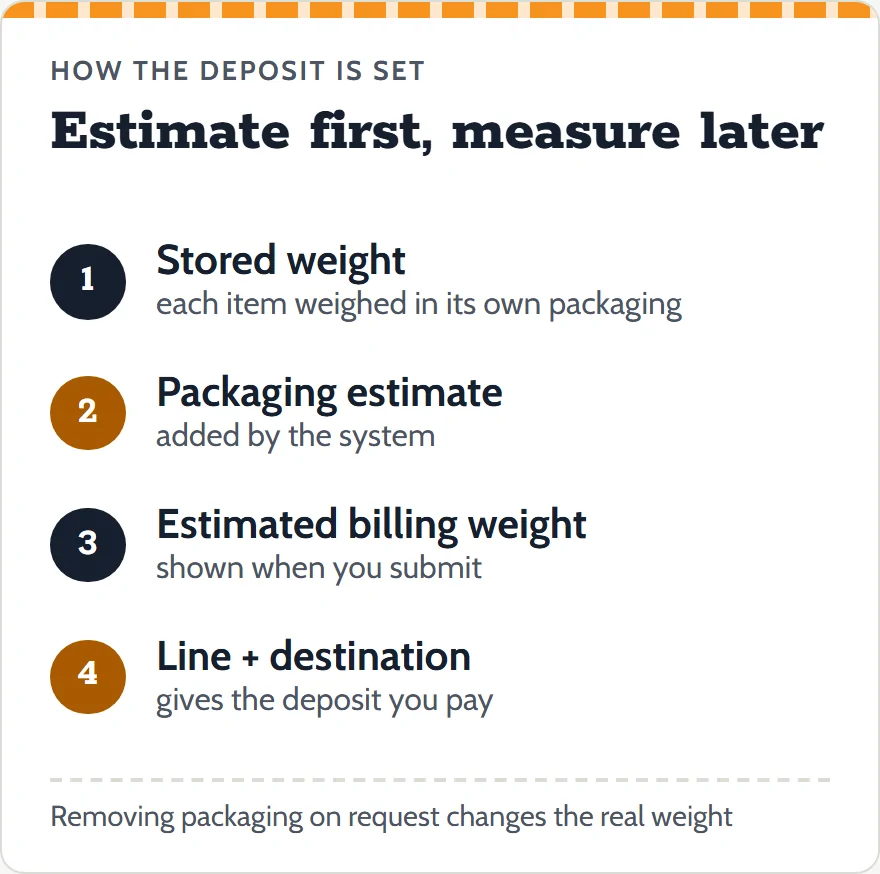
Step 7 of OrientDig's buying tutorial is titled "Pay Intl Shipping Fee", and it calls the payment a deposit outright: you "choose a payment method for the deposit on international shipping fees and customs fees". It then says how that deposit is set:
"The deposit for international shipping fees is determined based on the estimated weight of the product, the chosen shipping method, and the destination."
OrientDig help center, buying tutorial, edited June 30, 2025
The estimated weight is not a guess from nowhere. A separate article explains that every item is weighed in its original packaging when it is stored; when you submit a parcel, the system adds an estimate for packaging based on that stored weight. That total is the estimated billing weight. Ask for packaging to be removed and the real figure will differ, which is the first reason a deposit rarely matches the final bill.
Scale weight versus box size at four divisors
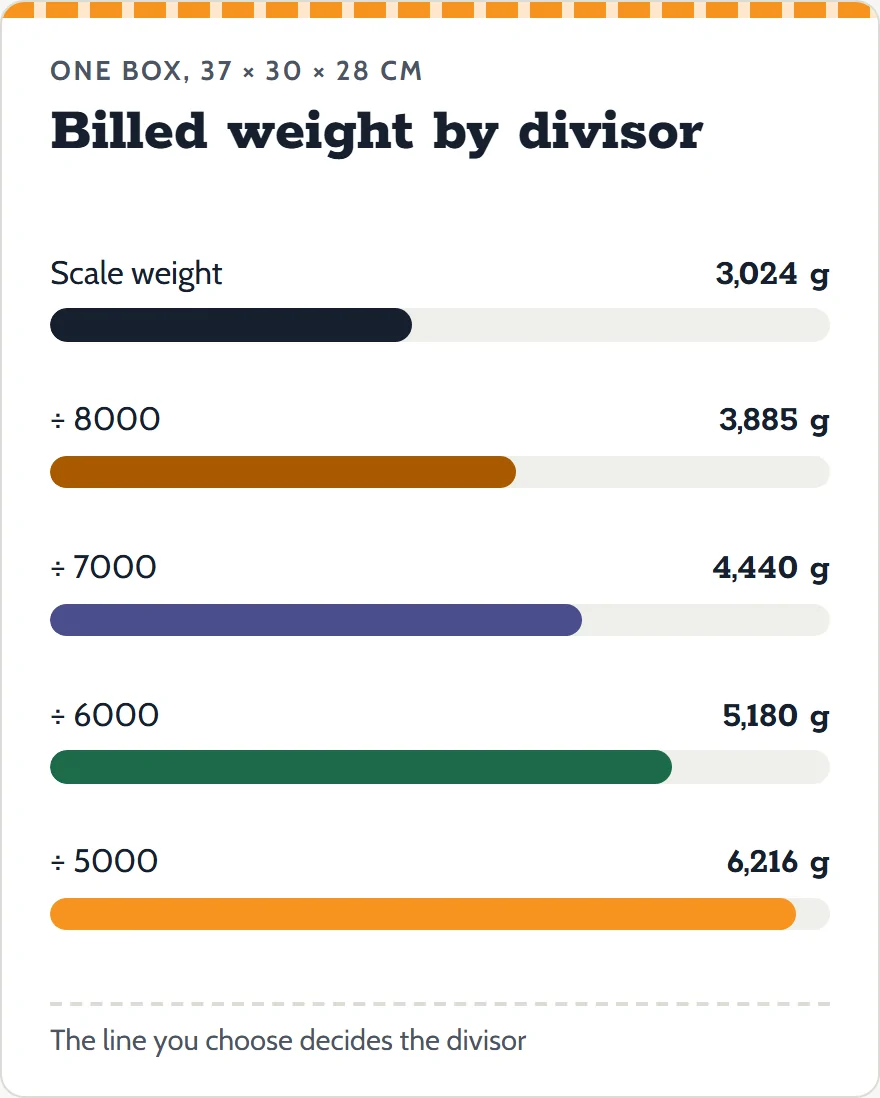
On some lines OrientDig charges whichever is greater, the actual weight or the volumetric weight. The billing-weight article multiplies the three box dimensions in centimeters, then divides by a carrier-specific number: 5000, 6000, 7000 or 8000.
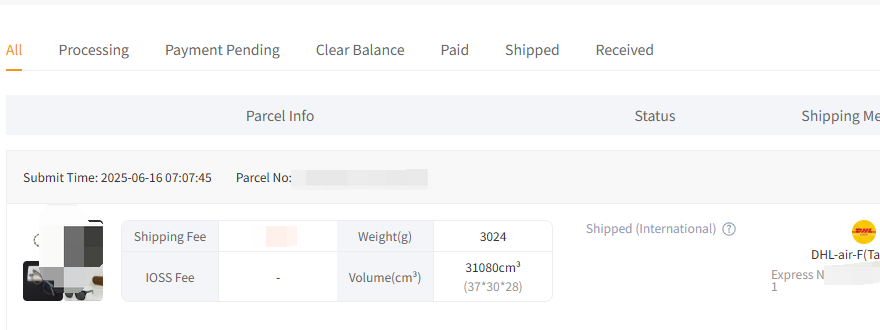
The operator's own 2025 parcel screenshot gives a real box to try it on. It weighed 3,024 g and measured 37 by 30 by 28 cm, which is 31,080 cubic centimeters. Run that through each divisor:
- divided by 8000: about 3,885 g, already more than the scale
- divided by 7000: 4,440 g
- divided by 6000: 5,180 g
- divided by 5000: about 6,216 g, more than double the actual weight
Which divisor applies depends on the line you pick, so the same box can be billed at four different weights. Puffer jackets, shoe boxes and handbags with stuffing are where this bites. Ask for packaging to be reduced only if the item can travel without it.
Divisors and totals from the November 9 shipping quotes
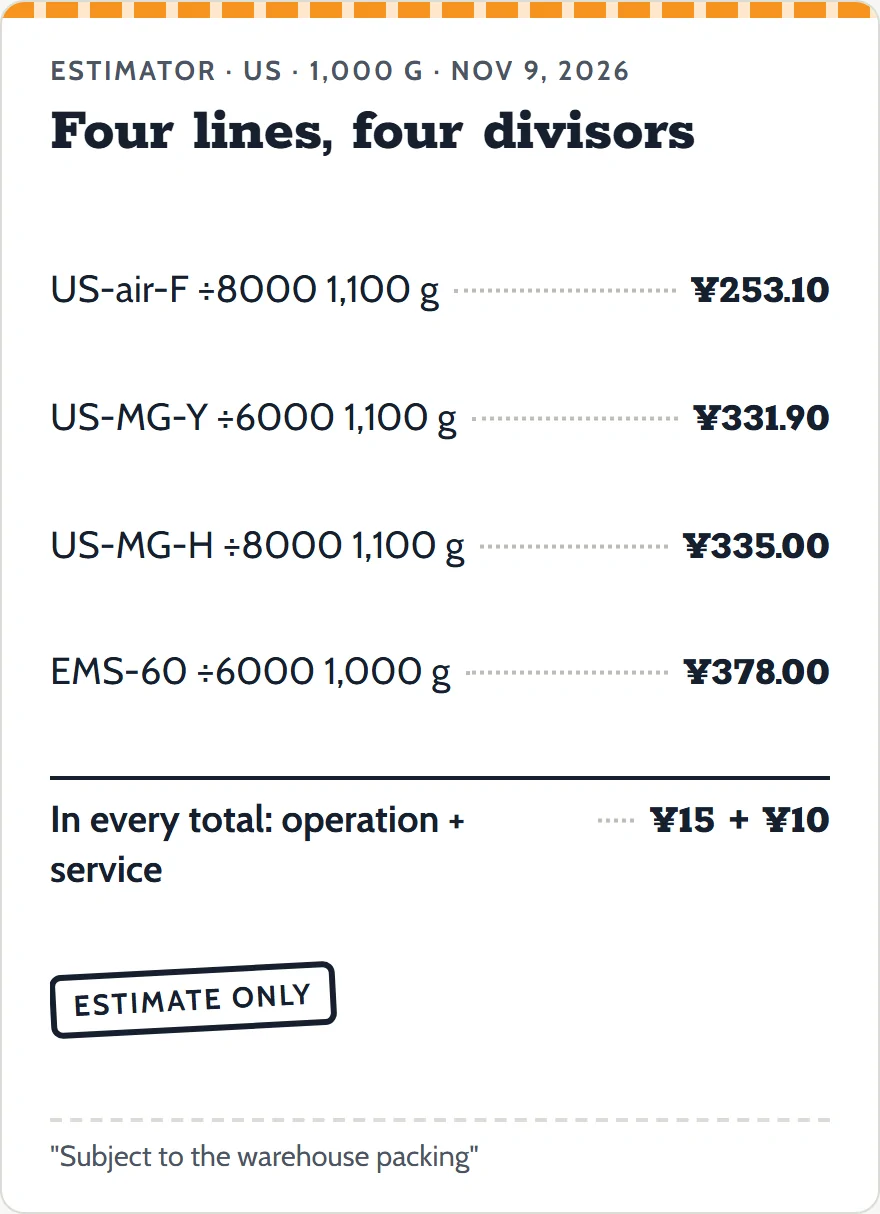
OrientDig's shipping estimator returns more than a price. For each line it lists the freight, a customs line, an operation fee, a service fee, the chargeable weight and the volume divisor. Asked on November 9, 2026 about a one-kilogram parcel bound for the United States, it listed four lines:
| Line | Total (CNY) | Chargeable | Divisor | Days |
|---|---|---|---|---|
| US-air-F | 253.10 | 1,100 g | 8000 | 8 to 17 |
| US-MG-Y | 331.90 | 1,100 g | 6000 | 8 to 19 |
| US-MG-H | 335.00 | 1,100 g | 8000 | 8 to 19 |
| EMS-60 | 378.00 | 1,000 g | 6000 | 5 to 12 |
Two details are easy to miss. Three of the four lines billed 1,100 g for a 1,000 g input: after the first 500 g they count in 200 g steps, so the weight was rounded up before any box size was entered. And every line carried a 15 CNY operation fee and a 10 CNY service fee per parcel. The help article on billing weight calls the estimator "for reference only, the actual charges are subject to the warehouse packing".
Final weight, the Details link and the difference
The final figure is fixed in two places. According to OrientDig's weight article, staff weigh the packed parcel and take its dimensions; if the logistics provider does not adjust them, that measurement is the actual billing weight. If the provider does adjust it, "the actual billing weight is based on the logistics provider's measurements".
You can see the result. The same article says the actual billing weight "can be inquired by clicking 'details' on the parcel page 3 days after" the parcel is sent out. In the operator's 2025 screenshot of that page, each parcel row shows Weight(g), Volume(cm³) with the box size, the line, and a Details link, under tabs that include Payment Pending and Clear Balance.
As for the money, the tutorial is direct about one direction: when the final fee and the deposit differ, "the difference will be refunded to your OrientDig account after the product has been shipped." It gives no number of days, and it does not describe the case where the final fee is higher; the Clear Balance tab on the parcel list is the only sign of that path we found.
Domestic Return: resending a parcel China held back
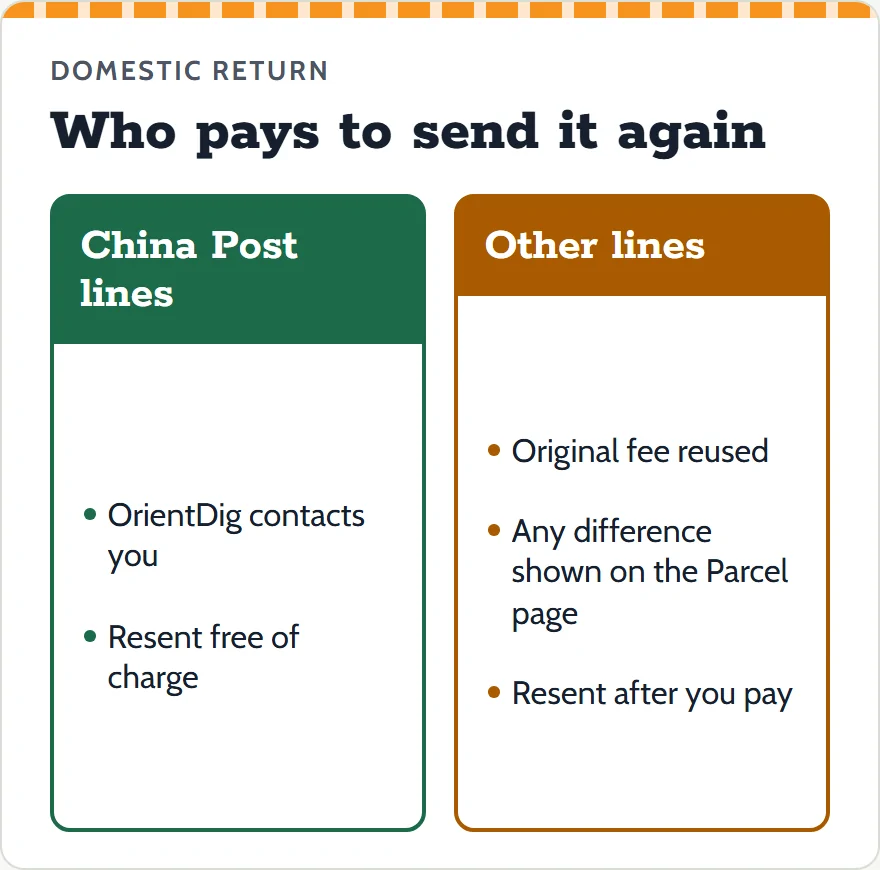
Some parcels never leave China. If one fails the domestic security check, it shows as Domestic Return and comes back to the warehouse. Who pays to send it again depends on the line you chose, according to the help center's domestic-return article:
- China Post lines: OrientDig will "contact you to confirm and resend it free of charge".
- Other lines: "the shipping fee you initially paid will be automatically applied toward the cost of resending the package." If the new route costs more, check the Parcel page for an additional payment; the parcel is resent once it is paid.
A parcel returned from abroad is a different status, Overseas return, for parcels that fail customs inspection or hit "other delivery problems". The pages we read do not set out its costs, so ask before you agree to a resend.
Shipping-bill lines kept apart from the freight balance
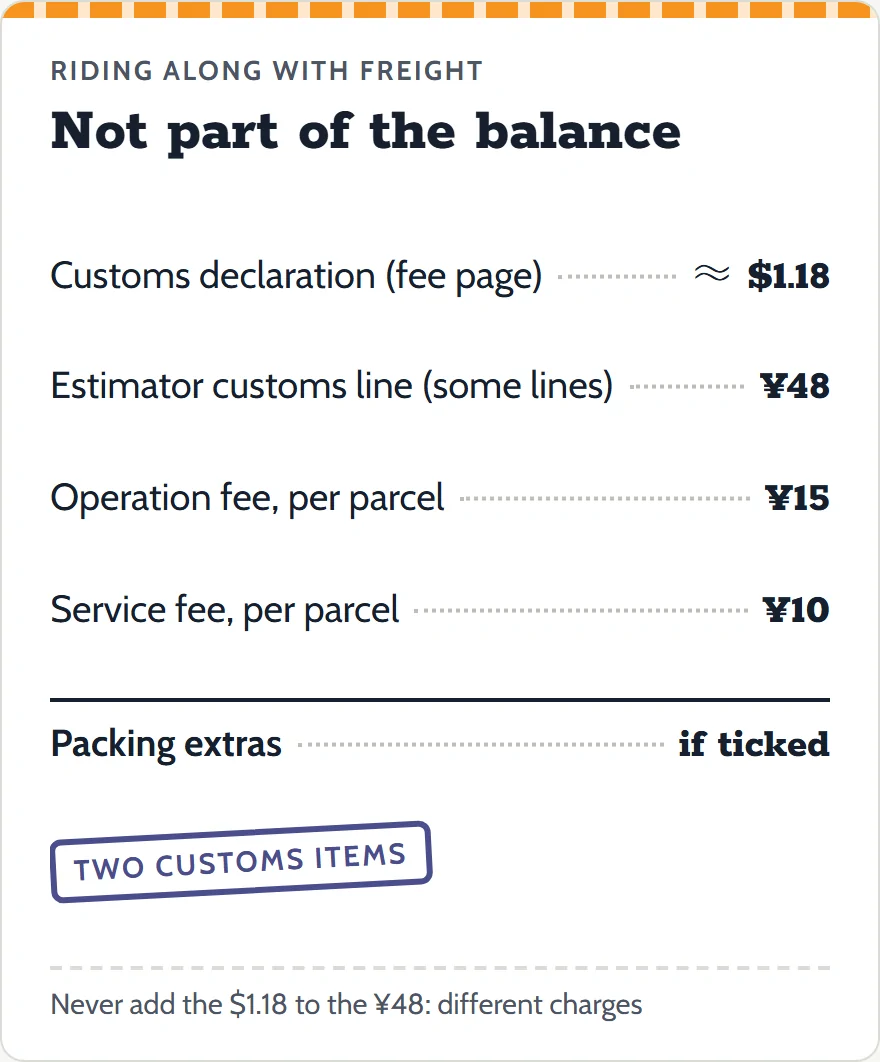
A few lines ride along with the shipping payment, and two of them share a name without being the same thing.
- Customs declaration. OrientDig's fee page says customs charges are "typically $1.18 for customs declaration and may vary based on the shipping method".
- The estimator's customs line. On November 9 some lines, such as the tax-included DHL lines to Germany, carried a separate 48 CNY customs entry; the US lines carried none. This is not the $1.18 charge, and the two should not be added together.
- Operation and service fees. 15 CNY and 10 CNY per parcel on every line that day.
- Extras you choose. Reinforcement, vacuum packing and similar options are priced on the submit page and only appear if you tick them.
None of these is a top-up on its own. They are known at the moment you pay the deposit, which is why the freight balance afterwards comes down to weight and size.